
By Chaplain George Freeman
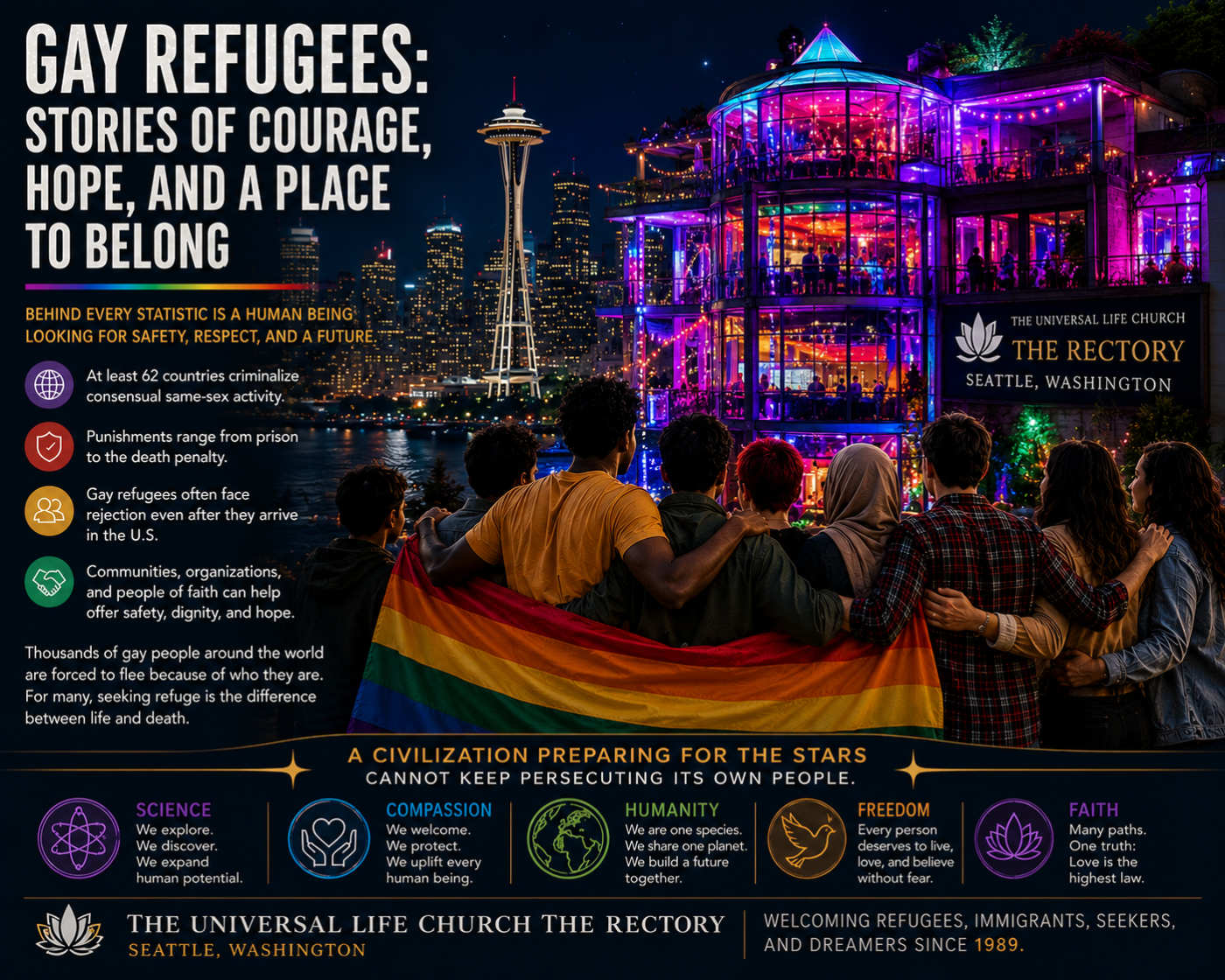
From the terraces of the Universal Life Church in Seattle, you can see the skyline, the water, the movement of a city constantly reinventing itself. On clear nights, the lights stretch toward the horizon and remind visitors of something larger than politics, larger than religion, larger than the endless arguments that consume modern life.
Humanity is standing at a crossroads. One road leads toward technology, exploration, scientific discovery, and a deeper understanding of our place in the universe. The other leads back toward tribalism, fear, persecution, and the ancient habit of turning human beings into targets simply because they are different.
The choice should not be difficult. Yet here we are.
Over the years, the Universal Life Church has employed more than fifty refugees and asylum seekers. Some escaped war. Some fled political oppression. Others arrived because their sexual orientation made them a target for imprisonment, violence, or death in their home countries.
These stories expose a contradiction that deserves far more attention than it receives. The United States has openly gay public officials, business leaders, military personnel, judges, professors, and cabinet members. Americans regularly celebrate achievement regardless of sexual orientation. Meanwhile, in dozens of countries around the world, individuals face criminal penalties simply for existing as they were born. No scripture, doctrine, or tradition changes the simple biological reality that human diversity exists throughout the natural world. It always has. It always will.
Let’s set the record straight: ancient history and nature have never been as rigidly binary as fundamentalists or traditionalists want you to think. For decades, the “religious” establishment has weaponized a sanitized, 1950s sitcom version of “Biblical family values,” but the actual archives prove that the divine has always been a whole lot more queerer than Sunday school let on.
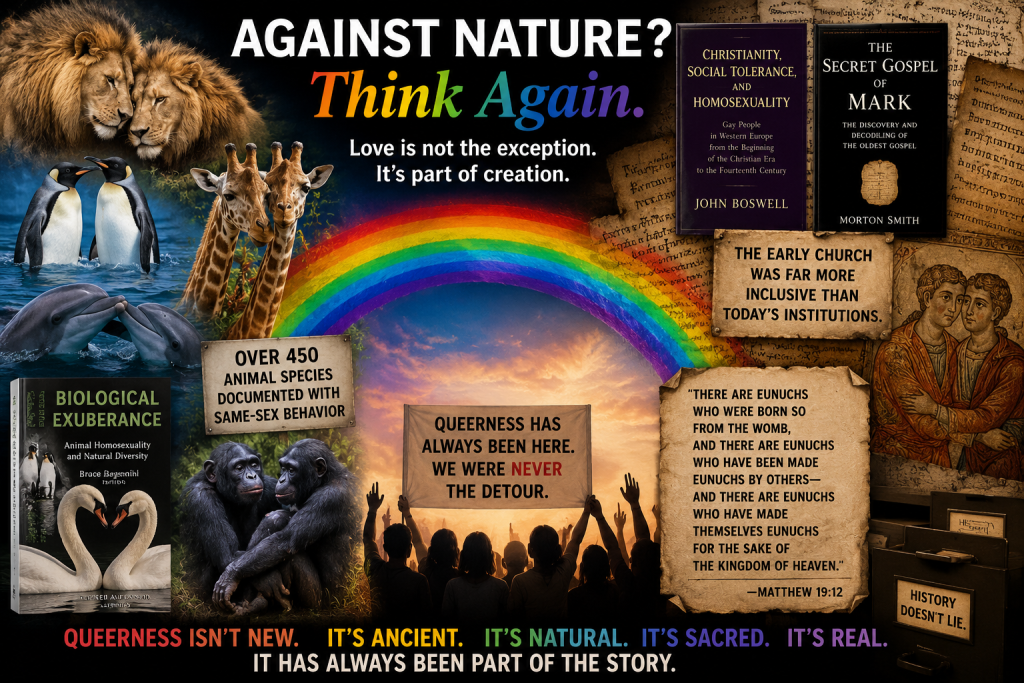
From the radical inclusion of biblical “eunuchs”—the ancient world’s ancestors to asexual, intersex, and trans identities whom Jesus explicitly validates in Matthew 19:10-12 and Philip baptizes without gatekeeping in Acts 8:26-40—to the fiercely intimate, non-heteronormative devotions of David and Jonathan (“passing the love of women,” 2 Sam 1:26), the “Beloved Disciple” leaning against Jesus’ chest (John 13:23), and the Centurion’s same-sex domestic pais (Matt 8), non-traditional relationships are baked right into the text.
Even when traditionalists claim homosexuality is “against nature,” heavy-hitting modern research like Bruce Bagemihl’s Biological Exuberance (1999) completely demolishes the argument by documenting thriving same-sex behavior in over 450 animal species, while historical game-changers like John Boswell’s Christianity, Social Tolerance, and Homosexuality (1980) and Morton Smith’s scandalous “Secret Gospel of Mark” (1973) prove the early Church was far more accepting than today’s institutions. The receipts are officially in, the archives are open, and the message is loud and clear: queerness isn’t a modern detour from faith—it has been part of the story all along.
Here is the hypocrisy nobody wants to discuss. Some religious cultures punish the gay man they call shameful while protecting the powerful man who exploits boys. That is not morality. That is hierarchy wearing holy clothes. History shows the same contradiction inside Western churches, where institutions condemned sexuality publicly while hiding abuse privately. The problem was never nature. The problem was power. The question is not whether diversity exists. The question is whether civilization is mature enough to live with it.
Extremists claiming religious authority threw human beings from buildings because of who they loved. Those crimes were documented by journalists, condemned by human-rights organizations, and rejected by millions of people across the world, including many within the same religious traditions the extremists claimed to represent.

(Open-source materials derived from international news reporting)
As a religious leader, I support religious liberty and the right of every person to worship according to their conscience. Faith has inspired extraordinary acts of compassion, charity, and service throughout history. However, religious freedom is not a license to imprison, torture, assault, or kill another human being because of who they are. The moment a belief system becomes a weapon aimed at another person’s life, dignity, or freedom, it ceases to serve the higher purpose it claims to defend. While humanity debates ancient prejudices, technology continues advancing at breathtaking speed. Artificial intelligence now bridges languages and cultures in seconds, medical science extends and improves lives, private companies are developing spacecraft capable of reaching farther than previous generations imagined, and scientists search the cosmos for evidence of life beyond Earth. Humanity is preparing for a future that would have sounded like science fiction only a few decades ago, yet some societies remain consumed by policing who another person loves. That is not progress. It is a distraction from the far greater challenges and opportunities facing our species.
If our species hopes to survive long enough to explore other worlds, solve climate challenges, cure diseases, and understand the universe, we must first learn how to stop waging war against members of our own family.
The greatest challenge facing humanity is not sexual orientation, race, nationality, or religion. The defining challenge of our time is whether we can overcome fear, tribalism, and division long enough to recognize a simple truth: every person on this planet belongs to the same species. From our mountaintop in Seattle, that lesson appears obvious. The refugees who arrive here are not statistics or political talking points. They are living evidence of both humanity’s capacity for cruelty and its remarkable resilience. Their experiences remind us that civilization is measured not by how passionately it proclaims its values, but by how consistently it practices them. The future will belong neither to the societies that perfect exclusion nor to those that build walls around fear. It will belong to those willing to create, discover, cooperate, and imagine. The stars above us are indifferent to our prejudices, and the universe does not recognize the divisions we invent. If humanity hopes to earn its place among the possibilities that lie ahead, we must learn to see difference not as a threat, but as an essential part of what it means to be human.